Home › Industrial and Heavy-Duty Asphalt Paving
Handle heavy loads with industrial asphalt paving in Corpus Christi, TX. We design and build pavements for truck yards, loading docks, and warehouses with thicker sections and reinforced bases. Our installations stand up to constant turning, stacking, and heavy equipment traffic.
Precision Asphalt Corpus Christi provides professional industrial asphalt paving throughout Corpus Christi, TX, Texas and the surrounding area. Our licensed, insured crew delivers safe, clean, on-time work with a free estimate before anything begins. Call (361) 266-1487 or request your free quote.
Industrial Asphalt Paving for Corpus Christi Facilities
Industrial asphalt paving is not the same as paving a small parking lot. Heavy trucks, forklifts, container loads, and constant turning movements all put a different kind of stress on the surface. Precision Asphalt Corpus Christi focuses on designs specifically for ports, refineries, distribution centers, plants, and heavy commercial yards in the Corpus Christi area.
We start by learning how your pavement will actually be used. That means asking about axle loads, traffic volume, whether trucks will be parked long term, and what type of equipment operates on site. A container yard near the Port of Corpus Christi needs a different pavement structure than a light warehouse with occasional deliveries. By matching the design to your operations, we reduce rutting, cracking, and shutdowns for emergency repairs.
Our crews are familiar with industrial sites across Nueces County and nearby coastal areas. We understand the impact of salt air, flooding, and intense summer heat on asphalt. That local experience shapes how we select materials, design drainage, and schedule work so your operations stay as efficient and safe as possible.
How Heavy-Duty Asphalt Paving Is Engineered
For heavy-duty and industrial asphalt paving, the most important decisions happen before any truck arrives with mix. Precision Asphalt Corpus Christi begins with a site inspection and, when needed, soil testing to understand the bearing capacity of the subgrade. Weak or clay-heavy soils are common here, especially on sites that were once fields or filled land, and they require specific treatment.
We design a pavement structure that includes the subgrade, base course, and asphalt lifts. For heavy truck lanes, loading docks, and container storage, we typically recommend thicker base rock and multiple asphalt lifts with higher quality binders. We may specify polymer-modified asphalt, larger aggregate in the base course, or reinforced geotextiles where the soil is soft. Each layer has a purpose: the subgrade carries the load, the base spreads it out, and the asphalt provides a smooth, durable surface.
Drainage is built into the design. In Corpus Christi, short but intense storms can put several inches of water on your pavement. If that water cannot get off or through the structure, it weakens the base and leads to potholes and pumping at joints. We look at existing elevations, nearby ditches or storm inlets, and how water moves across your site. Sometimes the most cost-effective upgrade is not thicker asphalt, but better drainage that protects the structure you already paid for.
Our Step-by-Step Heavy-Duty Paving Process
Precision Asphalt Corpus Christi follows a structured process that is tailored to industrial sites, where down time is expensive and safety is critical.
First, we plan the project with you and your operations team. We identify phases so parts of your facility stay open, set haul routes for our trucks that do not conflict with your traffic, and coordinate with any onsite safety or security requirements. On refineries or plants, this often includes site-specific safety orientations and adherence to PPE and escort rules.
Next, we prepare the subgrade and base. We remove unsuitable material, proof-roll to locate soft spots, and undercut and stabilize as needed. Base rock is placed, graded, and compacted in layers. In industrial applications we frequently use crushed limestone or recycled concrete base that meets TxDOT standards, then verify compaction with density testing so you know the structure under your asphalt is sound.
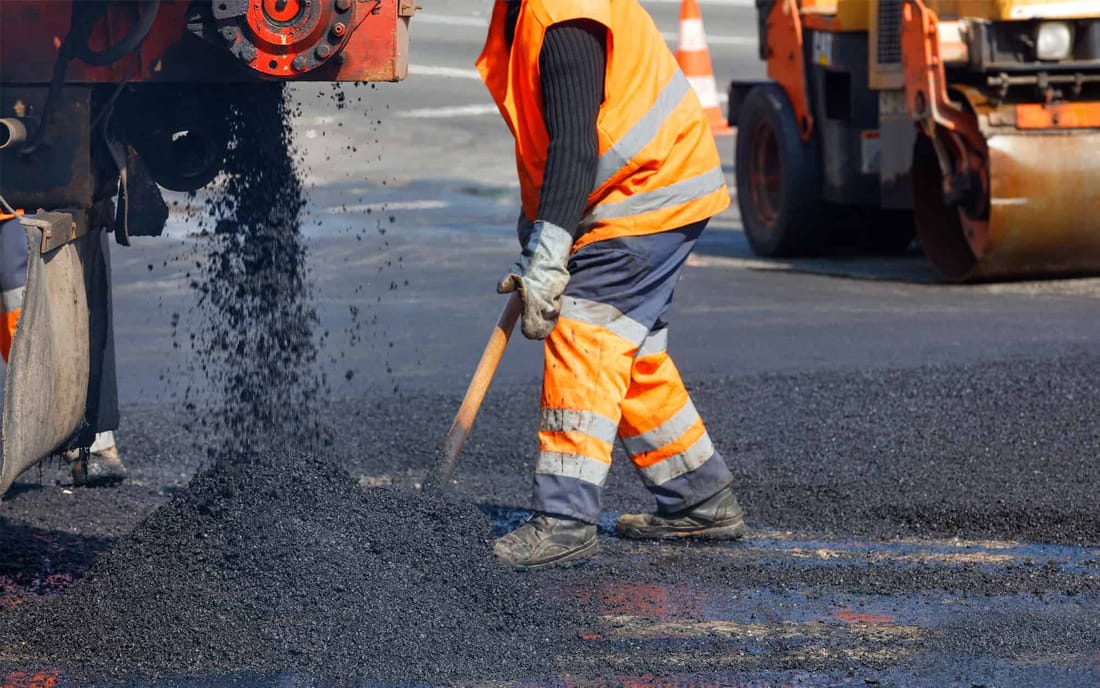
After the base is approved, we place asphalt in one or more lifts using commercial pavers. Joints are offset and compacted hot to reduce future cracking. For truck lanes, we may use a stiffer surface mix and increase thickness at turning or braking zones, such as scales and entry gates. Finally, we install striping, wheel stops, bollards, and signage as needed so the pavement is ready for safe use as soon as it cools.
Material Options for Industrial Asphalt Surfaces
Industrial customers in Corpus Christi have more options than simply choosing a black surface and a thickness. Precision Asphalt Corpus Christi can explain the tradeoffs between different asphalt mixes and structural designs based on your budget and risk tolerance.
For the heaviest duty areas, such as loading docks, refuse truck routes, or fuel delivery lanes, we often recommend a full-depth asphalt section or a thicker base with a high-stability surface course. These mixes have a higher stone content and stiffer binders, which resist rutting under slow, heavy loads. In laydown yards or infrequently used truck courts, a slightly lighter section may be appropriate if the subgrade is strong and drainage is well managed.
Additives can extend pavement life in our hot Gulf Coast climate. Polymer-modified binders improve resistance to shoving and rutting during high temperatures. Anti-strip agents help the asphalt bond to aggregates in locations exposed to standing water. For facilities where petrochemicals or oils are common, we may recommend seal coats or surface treatments that resist softening from spills.
We can also combine structural asphalt paving with areas of reinforced concrete where point loading is extreme. For example, concrete pads at dumpster pick-up points or at the front of loading docks, tied into surrounding heavy-duty asphalt, often give the best balance of cost and long-term performance.
What Drives the Cost of Industrial Asphalt Paving
Owners and facility managers often want to understand why two paving quotes can be far apart. Industrial asphalt paving costs in Corpus Christi are largely driven by four factors: thickness and materials, subgrade and base conditions, project phasing, and access.
Thicker sections and higher-grade asphalt mixes cost more initially but usually reduce life-cycle cost by delaying major repairs. If your site has weak or saturated soils, we may need additional base depth, stabilization with lime or cement, or geogrid reinforcement. That extra work adds cost, but skipping it often results in early failure under heavy loads.
Phasing and access matter as well. If production or shipping must stay active, we design smaller work zones, off-peak working hours, and temporary traffic control. This protects your operations but can increase labor and mobilization costs. Limited access for trucks or a requirement to stage materials offsite can also affect pricing.
Precision Asphalt Corpus Christi provides clear, itemized proposals so you can see what is included, where the money is going, and which items are optional upgrades. We can present alternate designs, for example a base design that meets minimum needs and a more robust option that better supports future expansion or heavier traffic.
Common Industrial Pavement Problems and How We Address Them
Heavy-duty pavements in Corpus Christi tend to fail in predictable ways, especially when exposed to heavy trucks, fuel spills, and standing water. Recognizing these patterns lets us design new projects and rehab work that actually solves the underlying problem.
Rutting in truck lanes and at stop points is common. This is usually caused by an asphalt section that is too thin or too soft for the loads, or a base that was not properly compacted. Our designs increase structural capacity specifically at braking, turning, and queuing areas, not just in the straight runs. We also specify mixes that hold up under high pavement temperatures, which can exceed air temperature by 20 to 30 degrees.
Alligator cracking in loading areas often indicates base or subgrade failure. Instead of simply overlaying, which only hides the problem, we cut out and rebuild the affected areas, replace weak base, and improve drainage so the issue does not return. Where repeated fuel or oil spills have softened the surface, we mill off the damaged asphalt, install a more resistant mix, and may add a seal or protective surface.
For facilities near the bay or low-lying areas, we see damage related to periodic flooding and trapped moisture. Here we focus on building more positive drainage, using free-draining base where appropriate, and ensuring joints and edges are sealed so water cannot easily enter the structure.
Local Permitting, Scheduling, and Why Local Experience Matters
Industrial and heavy-duty paving projects are tied into local rules and practical realities that are easy to overlook. Precision Asphalt Corpus Christi works regularly within the City of Corpus Christi and surrounding jurisdictions, so we understand when right-of-way permits, traffic control plans, or stormwater measures are required.
For example, if your project involves driveways that tie into a city street, you may need city review and an approach built to specific standards. Large industrial expansions can trigger stormwater pollution prevention requirements under state rules. We coordinate with your engineer or GC on documentation and, when requested, help gather the information needed for submittals related to paving.
Scheduling is also shaped by Corpus Christi weather and your operations calendar. Summer heat affects both asphalt placement and cooling times, which we consider when setting shift hours and production rates. During periods when your facility has outages or slow seasons, we can concentrate activity to get the most disruptive work done in the least amount of time.
Because we are based here, our crews are accustomed to working around port traffic, refinery access controls, and industrial safety standards. We value long-term relationships with local businesses, and that means we design and build pavement that holds up to the specific conditions we all live with on the Texas coast.